
Aging, Health & Nutrition Research Program
AHNRP
The Aging, Health & Nutrition Research Program (AHNRP) is a core program of Hope to Live Charity Organization designed to ensure that all our interventions for senior citizens are evidence-based, relevant, and responsive to real community needs.
As Kenya’s population of older persons continues to grow, many senior citizens aged 60 years and above face complex and interconnected challenges, including chronic illness, inadequate nutrition, food insecurity, limited access to healthcare, and social isolation. Unfortunately, many programs targeting the elderly are implemented without sufficient localized data to fully understand these challenges.
AHNRP exists to close this gap.
Through community-based research, the program generates practical knowledge that directly informs the design, implementation, and scaling of Hope to Live’s health and nutrition projects for elderly persons and their households.
What is the program about?
The Aging, Health & Nutrition Research Program focuses on generating high-quality, community-level evidence on the conditions affecting senior citizens (60+) in Kenya.
The program:
Conducts research on health, nutrition, and social wellbeing of older persons
Identifies priority needs, gaps, and barriers faced by elderly households
Translates research findings into actionable project designs
Strengthens advocacy and engagement with county and national stakeholders
Research activities under AHNRP are practical, ethical, and designed to lead directly to action.
How the Program Informs Our Projects
All Hope to Live projects targeting senior citizens are grounded in evidence generated through AHNRP. Research findings are used to
Identify priority communities and beneficiary groups
Design targeted and cost-effective interventions
Develop project proposals for donors
Monitor and improve project effectiveness
Advocate for policy and system-level changes
This ensures that our interventions are not only compassionate, but also strategic and impactful.
Our research-to-action approach
AHNRP follows a clear and intentional pathway
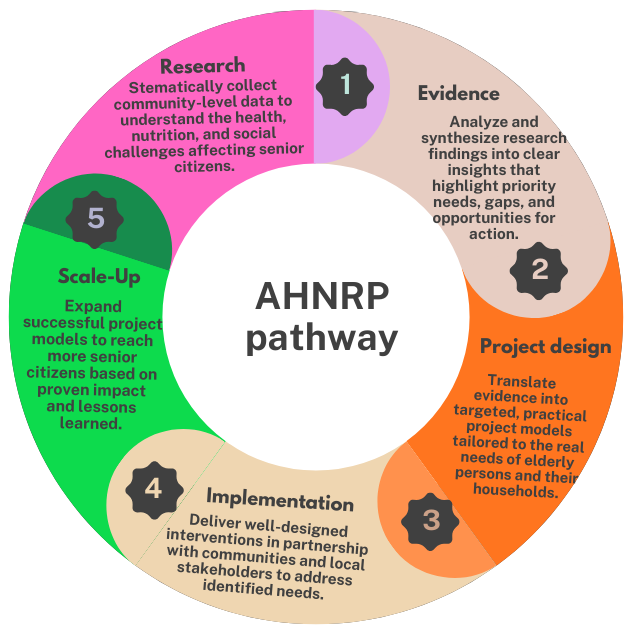
This approach ensures that research findings do not remain as reports, but are transformed into tangible interventions that improve the lives of senior citizens.
Every major project implemented by Hope to Live is informed by data generated through this program.
Key Research Areas
The program focuses on four interconnected research areas:
1. Healthcare Access and Health Outcomes
We examine how senior citizens access healthcare services and manage chronic conditions. Research topics include:
Prevalence of chronic illnesses among older persons
Access to health facilities, medicines, and health insurance
Barriers to healthcare utilization
Health-seeking behaviors and referral pathways
Findings inform the design of healthcare-focused interventions, including medical outreach programs and health system navigation support.
2. Nutrition and Food Security
Nutrition is a critical determinant of health among older persons. Under this theme, we assess:
Dietary diversity and meal frequency among senior citizens
Levels of food insecurity in elderly-headed households
Links between nutrition, medication adherence, and health outcomes
Coping strategies used by elderly households during food shortages
This research directly informs nutrition support programs, food assistance initiatives, and sustainable food security projects.
3. Social and Household Dynamics
Social factors significantly influence health and nutrition outcomes for older persons. Research in this area explores:
Living arrangements and caregiving structures
Social isolation and its impact on wellbeing
Household roles and responsibilities of elderly persons
Community support systems and gaps
Insights guide the development of social support, caregiver assistance, and community engagement initiatives.
4. Gender and Vulnerability
Older persons experience vulnerability differently based on gender, disability, and social status. This research area focuses on:
Gender disparities in access to healthcare and nutrition
Vulnerabilities faced by elderly women, widows, and persons with disabilities
Intersection of aging, poverty, and social exclusion
Findings help ensure that Hope to Live’s projects are inclusive and reach the most marginalized elderly populations.